How to Use SunOnly
SunOnly offers a unique approach to weather display that fundamentally differs from other weather apps. Here's how to get the most out of the app:
1. Select criteria
Version 2 introduces two different ways to define your dream weather criteria.
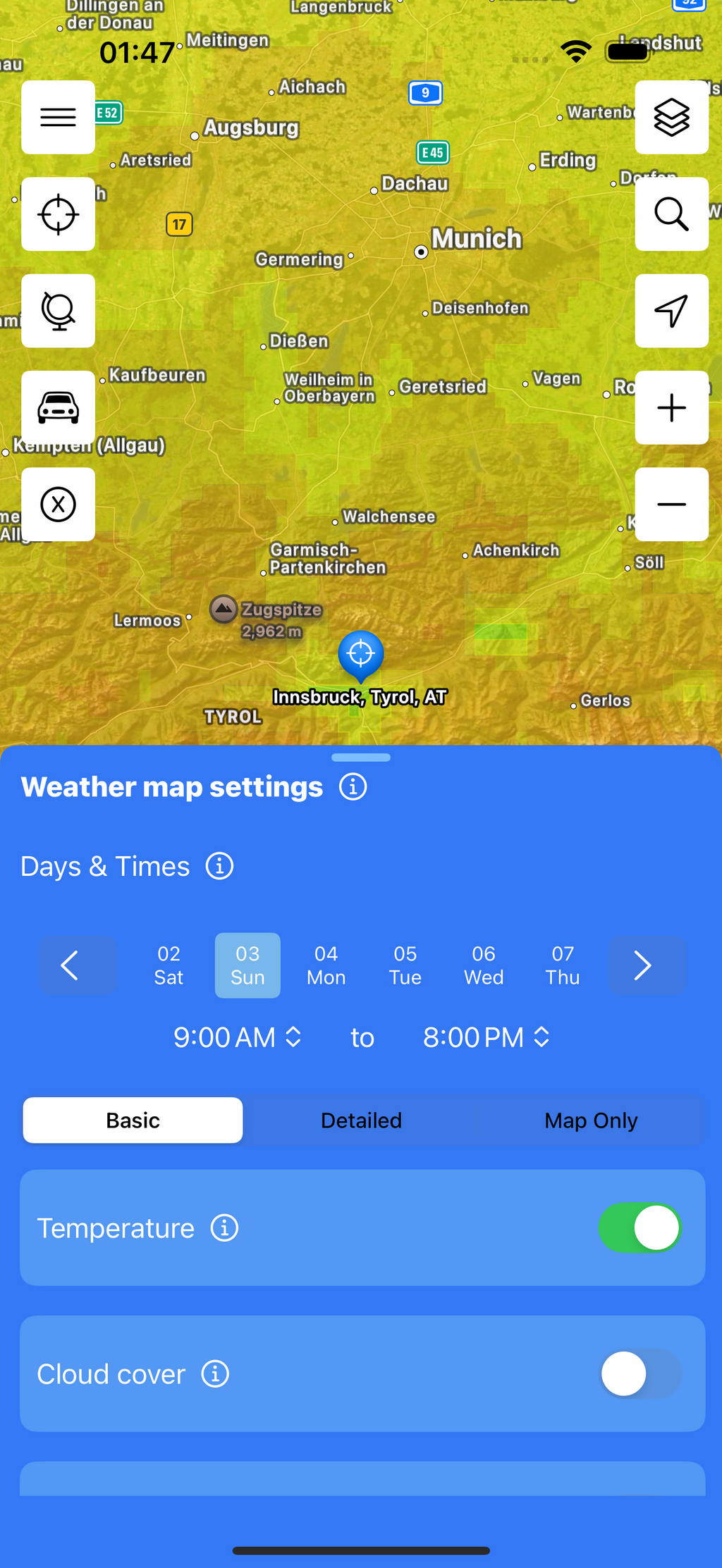
The first mode is already familiar and is now called “Basic Weather Search.” In this mode, you select the criteria that matter most to you, such as pleasant temperatures, minimal rain, snow, cloud cover, wind, etc. Compared to version 1, this mode has been simplified—partly to make it less confusing for users and partly because some functionality now resides in the new mode.
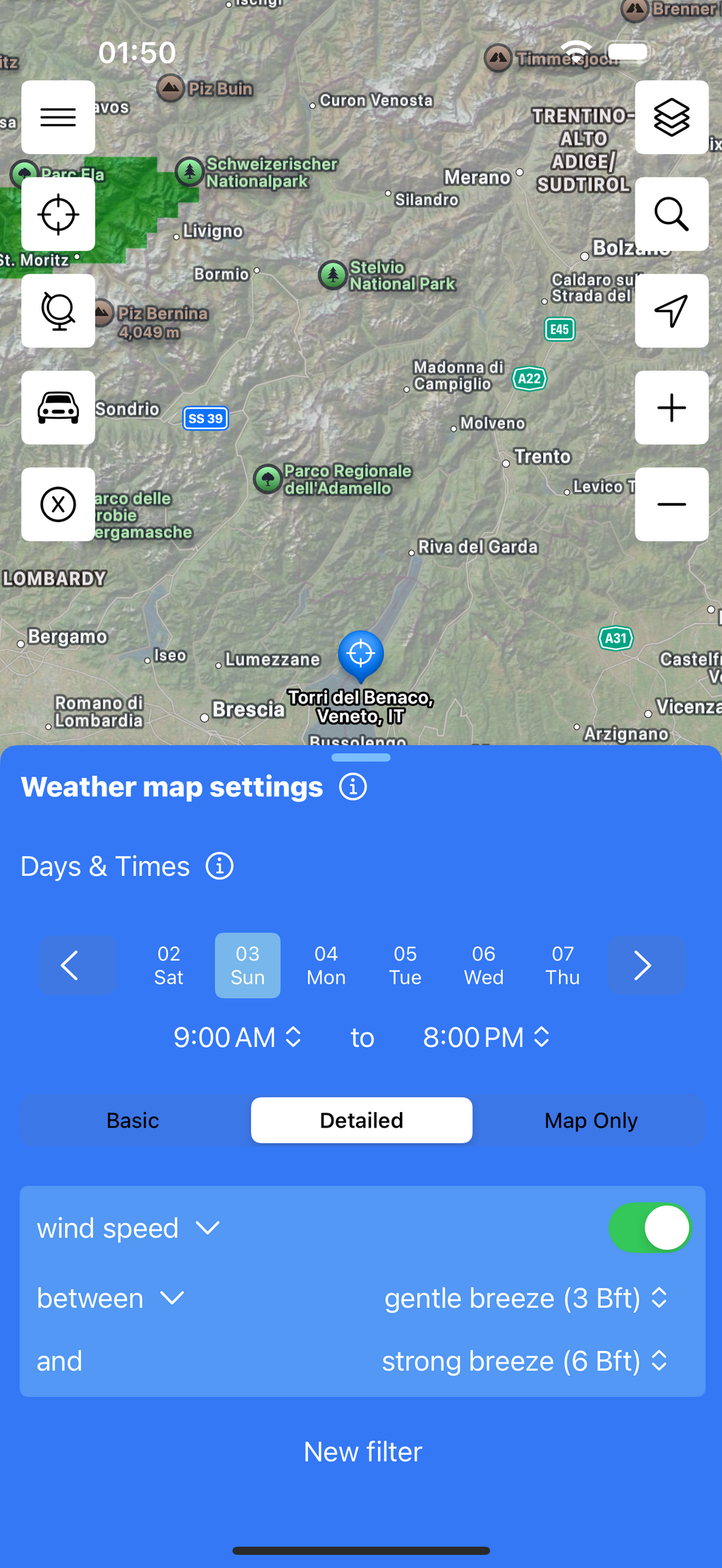
The second mode is new in version 2 and is called “Detailed Weather Search”. In this mode’s settings, you can define filtering rules for your dream weather. You can set the criteria for temperature, rain, snow, cloud cover, wind, etc., with much greater precision.
2. Select days
Decide how many days you want the weather forecast to be evaluated for.
3. Set time of day
Choose the times of day you want to consider for weather conditions.
4. Search for locations (optional)
If you’re looking for specific places, use the search function to find them quickly.
5. Select map area
Zoom in on the desired map area to get a regional overview.
6. Show weather details (optional)
For detailed weather information, tap on a point on the map or choose a location from the search. In the weather details, you'll see specific data like temperature, precipitation, wind speed, and sunshine hours for the selected location. Additionally, each location is rated from 0.5 to 5 stars, with half-star increments for more accuracy:
- 5 stars indicate ideal weather according to your criteria (dark green)
- 0.5 stars indicate the lowest match with your criteria (red)
7. Interpret colors
In the Basic Weather Search, you’ll see a colored weather map with gradients. Green areas show regions where your selected criteria are optimal during the defined period. For temperatures, this means they’re as pleasant as possible. Deviations up or down lower the score. For all other criteria, lower values are best—i.e., little or no rain, snow, clouds, wind, etc. Red areas show where the weather during that period is not favorable. Intermediate shades like light green, yellow, and orange indicate how well the weather meets your criteria in each area.
If multiple criteria are selected, the overall rating is determined by the lowest individual score among all active criteria.
In Detailed Weather Search, there are two modes:
- “Always Perfect”: The map uses only two colors. In all green regions, you’ll find your ideal weather throughout the entire selected period—meaning all filter criteria are met at all times. In gray regions, this is not the case, i.e., one or more criteria are not met.
- “Time-Based Evaluation”: The colors show the percentage of time during the selected period in which all criteria are fully met. Dark green areas indicate your ideal weather all the time, orange areas indicate it’s only partially ideal, and red areas indicate that your ideal weather does not occur at all.
8. Points of Interest
When you zoom into the map, so-called Points of Interest appear at a certain zoom level (depending on the map settings and the edition you are using).
In the map settings, you can choose whether and which Points of Interest should be displayed, depending on your preferences. These can include campsites and motorhome parking spots, supply and disposal stations, public toilets and showers, swimming pools and fitness centers, parking areas, gas stations, as well as doctors, veterinarians, hospitals, police, and much more.
With this step-by-step guide, you can make the most of SunOnly and easily find the places with the best weather for your activities.
Disclaimer: A weather forecast is always an estimate and inherently subject to uncertainty. The further into the future the forecast goes, the less reliable it becomes. Both the underlying weather data and the calculations may contain errors. No liability is assumed for the accuracy of the forecast.